Rsa Decryption Key Calculator
Advanced Encryption Standard(AES) is a symmetric encryption algorithm. AES is the industry standard as of now as it allows 128 bit, 192 bit and 256 bit encryption.Symmetric encryption is very fast as compared to asymmetric encryption and are used in systems such as database system. Following is an online tool to generate AES encrypted password and decrypt AES encrypted password. It provides two mode of encryption and decryption ECB and CBC mode. For more info on AES encryption visit this explanation on AES Encryption.
RSA Calculator JL Popyack, October 1997 This guide is intended to help with understanding the workings of the RSA Public Key Encryption/Decryption scheme. No provisions are made for high precision arithmetic, nor have the algorithms been encoded for efficiency when dealing with large numbers. Step # 1: Generate Private and Public keys. Enter two prime numbers below (P, Q), then press calculate: P: Q: Some prime numbers: 11, 13, 17, 19, 23, 29, 191, 193, 197, 199, etc. Another way of calculating 'L' is to list of numbers from 1 to N, remove numbers which have common factor which N and count the remaining numbers. RSA Express Encryption/Decryption Calculator This worksheet is provided for message encryption/decryption with the RSA Public Key scheme. No provisions are made for high precision arithmetic, nor have the algorithms been encoded for efficiency when dealing with large numbers.
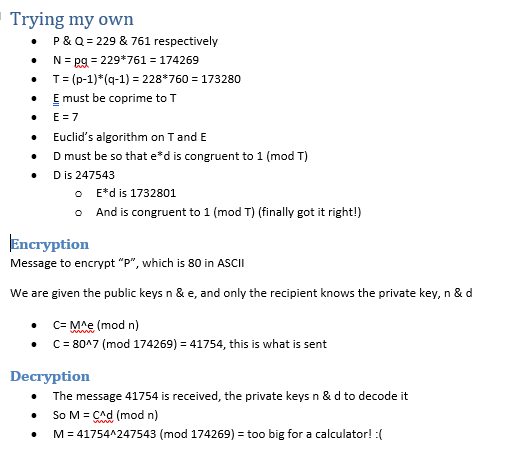
Also, you can find the sample usage screenshot below:
If You Appreciate What We Do Here On Devglan, You Can Consider:
- Like us at: or follow us at
- Share this article on social media or with your teammates.
- We are thankful for your never ending support.
Usage Guide
Any plain-text input or output that you enter or we generate is not stored on this site, this tool is provided via an HTTPS URL to ensure that text cannot be stolen.
For encryption, you can either enter the plain text, password, an image file or a .txt file that you want to encrypt. Now choose the block cipher mode of encryption. ECB(Electronic Code Book) is the simplest encryption mode and does not require IV for encryption. The input plain text will be divided into blocks and each block will be encrypted with the key provided and hence identical plain text blocks are encrypted into identical cipher text blocks. CBC mode is highly recommended and it requires IV to make each message unique. If no IV is entered then default will be used here for CBC mode and that defaults to a zero based byte[16].
The AES algorithm has a 128-bit block size, regardless of whether you key length is 256, 192 or 128 bits. When a symmetric cipher mode requires an IV, the length of the IV must be equal to the block size of the cipher. Hence, you must always use an IV of 128 bits (16 bytes) with AES.
AES provides 128 bit, 192 bit and 256 bit of secret key size for encryption. Things to remember here is if you are selecting 128 bits for encryption, then the secret key must be of 16 bits long and 24 and 32 bits for 192 and 256 bits of key size. Now you can enter the secret key accordingly. By default, the encrypted text will be base64 encoded but you have options to select the output format as HEX too.
Similarly, for image and .txt file the encrypted form will be Base64 encoded.
Below is a screenshot that shows a sample usage of this online AES encryption tool.
AES decryption has also the same process. By default it assumes the entered text be in Base64. The input can be Base64 encoded or Hex encoded image and .txt file too. And the final decrypted output will be Base64 string. If the intended output is a plain-text then, it can be decoded to plain-text in-place.
But if the intended output is an image or .txt file then you can use this tool to convert the base64 encoded output to an image.
Please enable JavaScript to view the comments powered by Disqus.Other Free Tools
Checksec:
Running binary:
Main function:
First bug: menu_input can be -1 or 0 resulting in func array underflow.
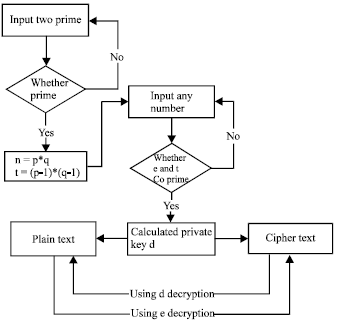
Rsa Decryption Key Calculator 2020
Set key function looks ok. It just gets key params as unsigned ints, validate them, compute some other params and save them all in global section. Only validation part is not super restrictid:
Rsa Decryption Key Calculator
Encryption:
Variables:
int g_ebuf[256](global encryption buf)char g_pbuf[1024](global plaintext buf)int data_counteris at most 1024
Bug1 is that g_ebuf will overflow (256 vs 1024). Bug2 is that encrypted_result will overflow (and is not fully zeroed). In general, data_counter should count words (4 bytes) instead of bytes. Also note that it doesn’t implement real RSA, encryption is done byte-by-byte.
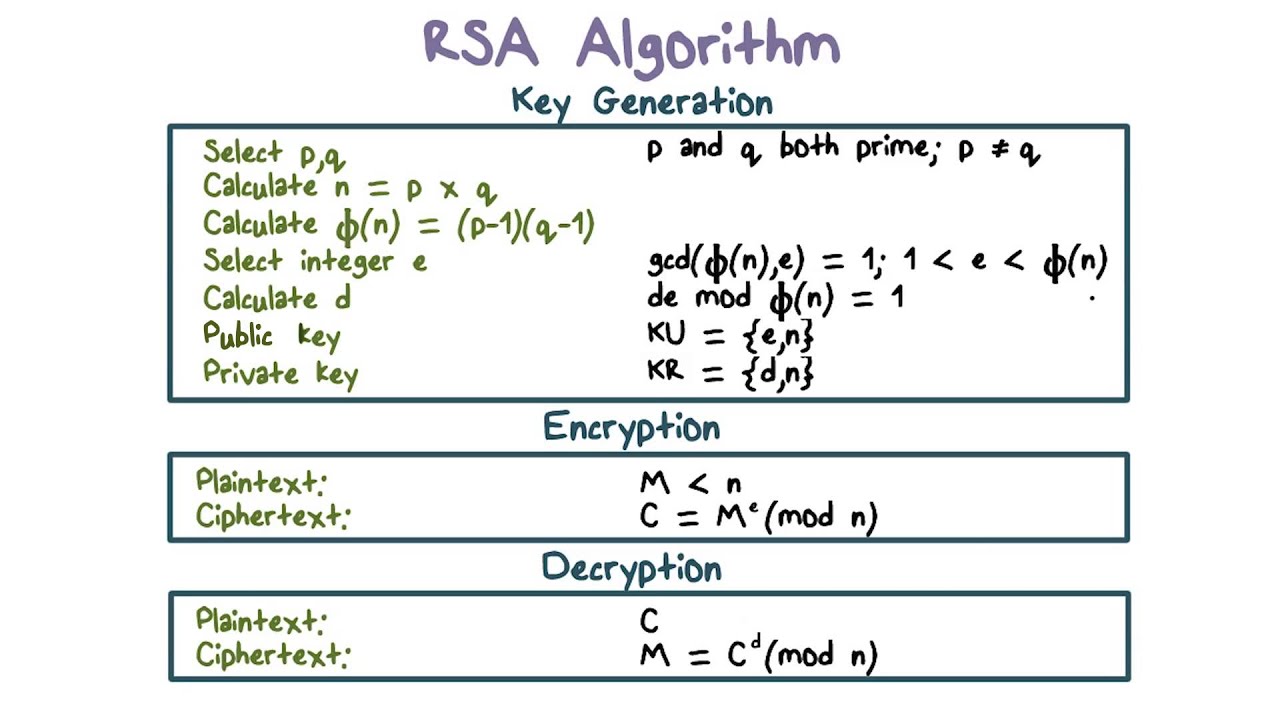
Rsa Encryption Explained
Decryption function:
Bugs:
- 1: in the loop with
sscanfwith “%02x”: it is two-times too long. - 2:
ciphertextis 512 bytes long, butmemcpymay copy up to 1024 bytes - 3:
data_counter / 8should bedata_counter / 4 - 4: format string bug
We can go with bug1 in encryption function (g_ebuf overflow). Globals layout is:
So we need 256 + 1 + 7 bytes of padding and then pointer to shellcode (for example). Main drawback is that the pointer have to be “encrypted”. That is we need to send some x, such that pow(x, e, n) address. For that we may use dsks function from CryptoAttacks (it’s “Duplicate-Signature Key Selection” attack described in cryptopals set8). Another thing: program treats params as signed ints, so care should be taken not to overflow anything.
The shellcode may be placed in g_pbuf. As we have system address in global section, the shellcode just needs to set args and jump to it.